The Caffeine Tail · Part 3 of 3
Bottled Paraxanthine
Beginner
You may have seen paraxanthine on a supplement label, sold as a caffeine alternative: energy and focus without the jitters, and easier on your sleep. It's the compound your liver makes out of most of the caffeine you drink, and it's a stimulant in its own right.
Our founder came at it from the other end. Before chocolate or bedtimes came into it, his first question was a shopping question: caffeine breaks down into something, so what is it, can you buy it, does it work, and has anyone studied it properly? You can buy it, in capsules and pre-workout drinks. The rest of it comes down to the promise on the label, which is a promise about how it feels.
How it felt to one person
Our founder tried it and rated how strong it felt, on a scale from 0 for nothing to 10. Fifty milligrams of paraxanthine felt like 3 out of 10. A 120 mg dose of caffeine felt like 5.5.
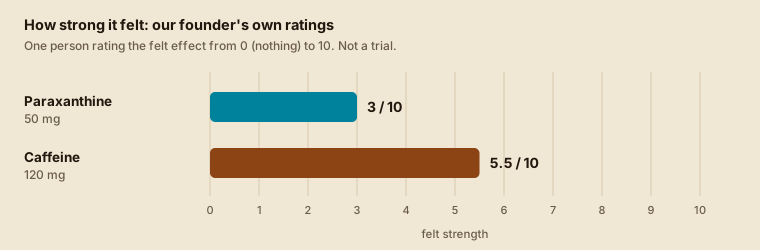
Milligram for milligram, that's roughly the same kick, and possibly a little more for the paraxanthine. It's one person on one scale. It's also, as far as we can tell, more than the published research has.
What the research asked people
A handful of human studies asked people how it felt:
- Jitters and anxiety: people on 100 to 300 mg didn't feel more anxious than on a dummy pill. But in the one study that also gave caffeine and asked about side effects, hardly anyone reported jitters on either, so it couldn't show a difference.
- Energy and focus: one short conference summary, from a supplement company, says people felt more energy and focus on 200 and 300 mg than on a dummy pill. Another trial registered plans to compare paraxanthine with caffeine and to rate energy and focus; the published paper reports neither.
- Sleep: fourteen rowers rated their sleep after an evening dose. Paraxanthine on its own didn't come out clearly different from caffeine or from the dummy pill. Taking both together was worst.
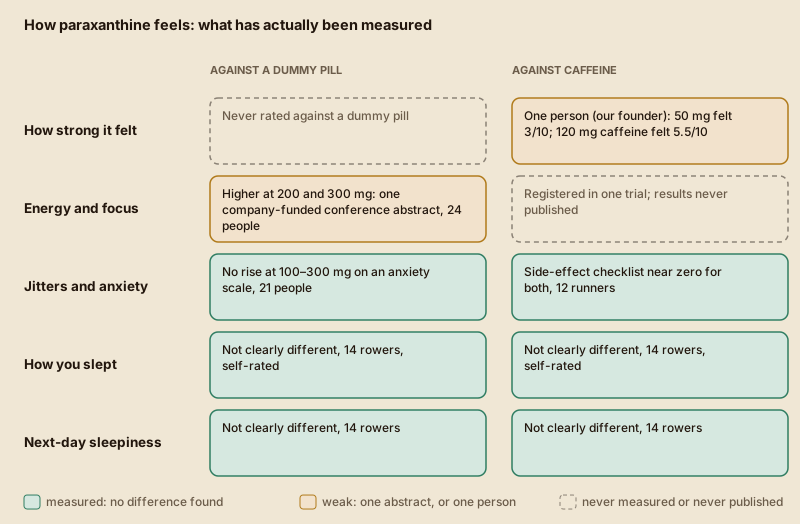
The "no jitters" idea mostly comes from a study in mice, where paraxanthine didn't raise anxiety and caffeine did.
Why it might still be easier on sleep
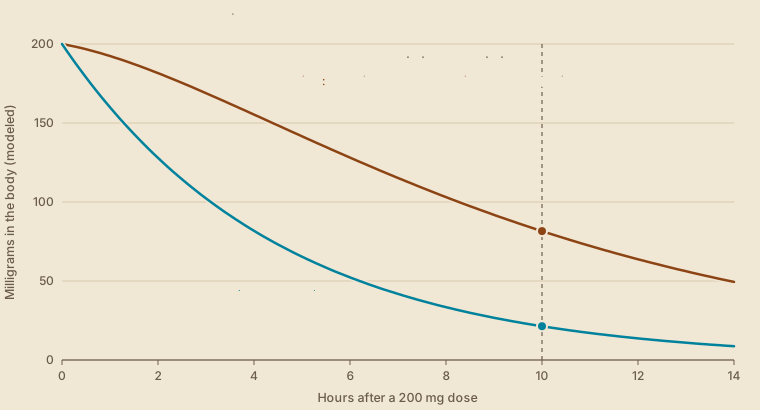
There's a real reason to hope. Paraxanthine clears a little faster than caffeine, and taking it directly skips caffeine's slow first stage, so much less should be left at bedtime. For a 1 p.m. dose, the model has about 21 mg left at 11 p.m., against about 82 mg from the same amount of caffeine. Whether you'd sleep better is the part nobody has measured properly.
What to do
If sleep is the problem, move your caffeine earlier first; Part 2 shows why. Don't add paraxanthine on top of your caffeine, because the combination was worst for sleep in the one study that tested it. If you want to try it, do what our founder did: take it instead of your afternoon coffee, at the same time of day, and rate it yourself. Score how strong it feels from 0 to 10, any jitters, and how tired you are the next morning, for a week of each. Ask a pharmacist first if you take regular medication, because your liver clears paraxanthine with the same enzyme that clears caffeine.
Health Canada's limit for healthy adults is 400 mg of caffeine a day, and 300 mg during pregnancy or breastfeeding.18 If you're pregnant or breastfeeding, take regular medication, or have a heart condition, the right amount and timing for you is a conversation with your doctor or pharmacist.
Paraxanthine is sold on how it feels, and the only side-by-side rating we found is our founder's. Yours will be the second.
Intermediate
The Felt Record
If you're weighing up a paraxanthine product, the question is how it feels next to the caffeine you already know: as much lift, less edge, a better night. That's what the label promises, and it's the question the published trials have barely asked.
One person's comparison
Our founder rated both on a 0–10 scale for felt strength: 50 mg of paraxanthine at 3, and 120 mg of caffeine at 5.5. Scaled per milligram, which assumes a straight line it probably doesn't follow, that's about 0.06 points per milligram for paraxanthine against 0.05 for caffeine: the same order of strength. It's one person and one scale, and it's the only direct felt comparison we found.
One thing to keep in mind with ratings like this: daily coffee drinkers are tolerant to most of caffeine's felt effects (Part 1 covers the studies), and we found no study testing whether that tolerance carries over to paraxanthine. A new stimulant can feel stronger simply because your body isn't used to it yet, so a daily drinker's comparison and a non-drinker's could come out differently.
What the trials asked
| Study | People | Felt measures | What they found | Who paid |
|---|---|---|---|---|
| Cognition, 20211 | 13 | Side-effect questionnaire hourly for 6 h | No side effects reported on 200 mg; energy and mood not rated | Ingredient maker |
| Dose-response, 20212 | 12 | Side-effect checklist (dizziness, fast heartbeat, nervousness and others) | Infrequent, minimal, no different from placebo at 50–200 mg | Ingredient maker |
| 10 km runners, 20243 | 12 | Same checklist; effort during the run | Near zero for paraxanthine, caffeine and placebo alike; effort no different | Ingredient maker |
| Appetite, 20244 | 21 | Anxiety, hunger, appetite scales | No rise in anxiety at 100–300 mg; less hunger at 200 mg | Ingredient maker |
| Energy and focus, 20256 | 24 | Energy, focus, productivity, fullness | Higher energy and productivity at 200 and 300 mg; 200 beat 300. Conference abstract only | Supplement company |
| Rowing and sleep, 20267 | 14 | Next-morning sleep quality; next-day sleepiness | Only caffeine plus paraxanthine was clearly worse than placebo; paraxanthine alone not clearly different from caffeine or placebo | No external funding |
A checklist that sits near zero can't separate two drugs: if almost nobody reports jitters on either, a study of a dozen people couldn't tell them apart even if one were twice as jittery as the other. Two more things stand out. Only two of these six gave caffeine as well, and neither rated energy, alertness or jitteriness on a proper scale. And the appetite trial's registration lists a 200 mg caffeine arm and ratings of focus, energy, concentration and confidence, registered five months after the data were collected; the paper reports its anxiety, hunger and appetite ratings but not the caffeine arm or the ratings of focus, energy, concentration and confidence.45
The "no jitters" claim traces mainly to animals. In mice, paraxanthine didn't raise anxiety-like behaviour where a similar dose of caffeine did.8 A 1995 human study, often cited for paraxanthine's gentler profile, found both drugs raised blood pressure and adrenaline similarly at the higher dose tested.10
Why the tail should still be shorter
Paraxanthine taken on its own has a half-life of about 3.1 hours against caffeine's 4.1,11 and taken directly there's no caffeine left to keep making more of it. Modeled for 200 mg at 1 p.m., that's about 21 mg left at 11 p.m. against 82 mg from caffeine. Part 2 of this series explains why an amount you can't feel at bedtime can still matter for sleep.
Safety and status
The formal toxicology is in rats, and both studies were industry-run or industry-funded.1415 Your liver clears paraxanthine with CYP1A2, the same enzyme that clears caffeine,13 so drugs that slow caffeine can be expected to slow it too. Searches on September 26, 2026 found no paraxanthine notice in the FDA's GRAS inventory and no licensed product listing it in Health Canada's natural health products database.1617
If you try it
- Use it instead of your afternoon caffeine: taking both together was the worst condition for sleep in the one trial that tested it.7
- Match time and dose: the same time of day as your usual caffeine, starting low; our founder's 50 mg was clearly noticeable.
- Rate it like he did: felt strength 0–10 an hour after, any jitters, and how tired you feel the next morning, for a week on each.
- Measure the night: a watch or ring for sleep, since Part 2 shows that how you think you slept misses most of caffeine's effect.
- Check with a pharmacist if you take regular medication.
What to change first
The time of your last caffeine. It costs nothing and has sleep trials behind it. Paraxanthine might give a similar lift with a shorter tail, and at the moment the only direct evidence on how it feels next to caffeine is one person's rating.
Health Canada's limit for healthy adults is 400 mg of caffeine a day, and 300 mg during pregnancy or breastfeeding.18 If you're pregnant or breastfeeding, take regular medication, or have a heart condition, the right amount and timing for you is a conversation with your doctor or pharmacist.
Advanced
Skipping the First Leg
Paraxanthine, the stimulant the liver makes from most of the caffeine you drink, is now sold on its own as a supplement, and its commercial case is subjective: comparable lift, less anxiety, better sleep. Its scientific case is pharmacokinetic: a shorter half-life, and no caffeine reservoir feeding it through the evening. The pharmacokinetic case is sound on paper. The subjective case has almost no human data behind it, and some of what was collected was never published.
The felt evidence, audited
| Study | n, arms | Subjective instrument | Result | Funding and interests |
|---|---|---|---|---|
| Yoo 20211 | 13; PX 200 mg vs placebo | Stimulant-sensitivity and side-effect questionnaire, hourly 1–6 h | "No subjective side effects"; no energy, alertness or mood scale | Ingredient maker; three authors its principals and patent inventors |
| Xing 20212 | 12; PX 50/100/200 mg vs placebo, acute and 7-day | 0–5 frequency and severity checklist (dizziness, headache, tachycardia, palpitations, dyspnoea, nervousness, blurred vision) | "Not significantly different among treatments"; per-item values only in a supplement | Same |
| Yoo 20243 | 12 runners; placebo, caffeine, PX, both (200 mg each) | Same checklist at baseline, 60 min post-dose and post-run; RPE | No treatment or treatment × time effect (nervousness p = .65 frequency, .98 severity). Only pairwise PX–caffeine difference: post-run dizziness severity 0.67 vs 0.08, favouring caffeine (uncorrected). RPE no different | Same |
| Gross 20244 | 21; PX 100/200/300 mg vs placebo | 100 mm VAS: anxiety, hunger, appetite | Anxiety: no group × time effect at any dose. Hunger blunted at 200 mg | Ingredient maker; three authors advise the PX manufacturer |
| Abou Sawan 20256 | 24; PX 200/300 mg vs placebo | Energy, focus, productivity, fullness, appetite | Energy and productivity up at both doses (p < .01), 200 > 300; focus and fullness up at 200. Conference abstract, no means reported | Supplement company; a PX patent inventor among authors |
| Bingol Diedhiou 20267 | 14 rowers (habitual intake ~335 mg/day); placebo, caffeine, PX, both, 45 min before an evening trial | Next-morning sleep quality (0–10); next-day Karolinska Sleepiness Scale | Only the combination differed from placebo (sleep p = .006, d = 1.13; sleepiness p = .006). Caffeine vs placebo p = .071. PX vs placebo and PX vs caffeine not significant; all conditions in the good-sleep, alert range | No external funding |
Three problems run through it. Most instruments are side-effect checklists sitting at the floor, which can't distinguish two drugs that both produce few side effects. Only two of these included caffeine, and neither rated energy, alertness or jitteriness on a continuous scale. And the one trial registered to do exactly that, with a 200 mg caffeine arm and ratings of focus, anxiety, concentration, energy, wakefulness and confidence, registered those outcomes about five months after data collection ended and published only the anxiety, hunger and appetite ratings, without the caffeine arm.45
Where "no jitters" comes from
Several of the human studies above cite a lower-anxiety profile, and none measured it against caffeine. The claim's roots are elsewhere. In mice, oral paraxanthine at 100 mg/kg didn't increase anxiety-like behaviour on marble-burying and elevated-plus-maze tests, while caffeine at 92.8 mg/kg did (p = .035).8 In rats trained to recognise caffeine, paraxanthine generalised poorly, the animal version of "it doesn't feel the same".9 In humans, the 1995 oral study frequently cited for a gentler profile found paraxanthine and caffeine raised diastolic blood pressure, plasma adrenaline and free fatty acids similarly at 4 mg/kg, with caffeine stronger at 2 mg/kg; its abstract reports no subjective measures.10 A plausible pharmacological difference, then, and an untested subjective one.
One person's rating
Our founder rated felt strength on a 0–10 scale: 50 mg of paraxanthine at 3 and 120 mg of caffeine at 5.5. It's unreplicated, it may not have been blind, and felt intensity isn't linear in dose. Taken at face value it's 0.060 points per milligram against 0.046: paraxanthine in the same potency range as caffeine, perhaps a little stronger. The only placebo-controlled energy data found 200 mg outperforming 300 mg,6 so felt strength may not rise with dose in a simple way either. A head-to-head rating like this is exactly what the unpublished caffeine arm could have provided.
The pharmacokinetic case
The 3.1-hour half-life was measured after giving paraxanthine itself, 250 mg by mouth to six men, alongside caffeine at 4.1 hours with similar clearance.11 Taken directly, P(t) = D·e^(−k_P·t); taken as caffeine, paraxanthine is formation-limited and trails caffeine's decay, with caffeine and some theobromine alongside it.12
Three caveats. If oral paraxanthine absorbs more slowly than caffeine, the curve shifts right and the bedtime gap narrows. If it needs a larger dose for the same felt effect, the advantage shrinks in proportion, though our founder's rating points the other way. And paraxanthine is itself cleared by CYP1A2,13 so a slow metaboliser still clears it slowly.
Safety and status
Toxicology is preclinical: an industry-affiliated rat and cell study of the sponsor's ingredient reported no adverse effects up to 300 mg/kg/day, the highest dose tested,14 and an industry-funded study of another supplier's paraxanthine reported a 90-day no-observed-adverse-effect level of 185 mg/kg/day against 150 for caffeine.15 We found no long-term human safety study. Searches on September 26, 2026 found no paraxanthine entry in the FDA GRAS Notice Inventory and no licensed product listing it in Health Canada's Licensed Natural Health Products Database; the FDA also posts newer notices to a separate docket we didn't search.1617
What would settle it
A blinded crossover giving paraxanthine and caffeine at several doses, early in the afternoon, with continuous ratings of felt energy, alertness and jitteriness for the following eight hours, and polysomnography plus a next-morning alertness rating that night, run without the ingredient's maker. If paraxanthine matched caffeine's felt lift with less jitteriness and better measured sleep, the label would be earned. If felt strength per milligram came out lower, the bedtime advantage would shrink, and if measured sleep came out the same, the short tail wouldn't be buying anything.
This is where the guidance stops. The lever with sleep trials behind it is still the time of your last caffeine, and nothing here amounts to a recommendation for paraxanthine.
Health Canada's limit for healthy adults is 400 mg of caffeine a day, and 300 mg during pregnancy or breastfeeding.18 If you're pregnant or breastfeeding, take regular medication, or have a heart condition, the right amount and timing for you is a conversation with your doctor or pharmacist.
Part 1 · The Second Wave covers what a coffee feels like, how tolerance changes it, and why the feeling ends so long before the caffeine does.
Part 2 · The Bedtime Ladder is about what caffeine does to sleep without you feeling it, and what moving the last cup two hours earlier is worth.
Sources
- Yoo C, Xing D, Gonzalez D, et al. Acute paraxanthine ingestion improves cognition and short-term memory and helps sustain attention in a double-blind, placebo-controlled, crossover trial. Nutrients 2021;13(11):3980. 13 adults, 200 mg; funded by the ingredient's maker, with three of its principals among the authors.
- Xing D, Yoo C, Gonzalez D, et al. Dose-response of paraxanthine on cognitive function: a double blind, placebo controlled, crossover trial. Nutrients 2021;13(12):4478. 12 adults, 50, 100 and 200 mg, acute and over 7 days; same sponsor.
- Yoo C, Xing D, Gonzalez DE, et al. Paraxanthine provides greater improvement in cognitive function than caffeine after performing a 10-km run. J Int Soc Sports Nutr 2024;21(1):2352779. 12 trained runners, 200 mg doses; same sponsor.
- Gross KN, Allen LE, Hagele AM, et al. A dose-response study to examine paraxanthine's impact on energy expenditure, hunger, appetite, and lipolysis. J Diet Suppl 2024;21(5):608–632. 21 adults, 100/200/300 mg; no change in anxiety; funded by the ingredient's maker.
- ClinicalTrials.gov. NCT05811923: Changes in metabolic rate and perceptual indicators after acute ingestion of paraxanthine. Registered 2023-03-20 after a 2022-10-12 completion; lists a 200 mg caffeine arm and ratings of focus, energy, concentration and confidence.
- Abou Sawan S, Jäger R, Bashir R. Acute paraxanthine ingestion increases energy, focus, and satiety, enhancing postprandial cognitive performance in young adults. J Int Soc Sports Nutr 2025;22(sup2):2550171. Conference abstract; 24 adults; funded by a supplement company.
- Bingol Diedhiou A, Yildirim UC, Ozdenk S, et al. Comparative effects of caffeine and paraxanthine on rowing performance and sleep quality: a randomized crossover study. J Int Soc Sports Nutr 2026;23(1):2650339. 14 male rowers, 200 mg doses 45 min before an evening 2,000 m time trial; sleep rated subjectively; no external funding.
- Okuro M, Fujiki N, Kotorii N, et al. Effects of paraxanthine and caffeine on sleep, locomotor activity, and body temperature in orexin/ataxin-3 transgenic narcoleptic mice. Sleep 2010;33(7):930–942. Mouse study: caffeine raised anxiety-like behaviour, paraxanthine did not.
- Orrú M, Guitart X, Karcz-Kubicha M, et al. Psychostimulant pharmacological profile of paraxanthine, the main metabolite of caffeine in humans. Neuropharmacology 2013;67:476–484. Rat drug-discrimination: paraxanthine generalised poorly to caffeine.
- Benowitz NL, Jacob P, Mayan H, Denaro C. Sympathomimetic effects of paraxanthine and caffeine in humans. Clin Pharmacol Ther 1995;58(6):684–691. 12 adults, oral 2 and 4 mg/kg; similar blood pressure and adrenaline effects at 4 mg/kg.
- Lelo A, Birkett DJ, Robson RA, Miners JO. Comparative pharmacokinetics of caffeine and its primary demethylated metabolites paraxanthine, theobromine and theophylline in man. Br J Clin Pharmacol 1986;22(2):177–182. Six healthy non-smoking men given each compound separately; half-lives caffeine 4.1 ± 1.3 h, paraxanthine 3.1 ± 0.8 h, theobromine 7.2 ± 1.6 h, theophylline 6.2 ± 1.4 h.
- Lelo A, Miners JO, Robson RA, Birkett DJ. Quantitative assessment of caffeine partial clearances in man. Br J Clin Pharmacol 1986;22(2):183–186. Five volunteers at steady state; fractional conversion of caffeine to paraxanthine 79.6%, theobromine 10.8%, theophylline 3.7% (83.9%, 12.1% and 4.0% of the demethylation routes alone).
- Gu L, Gonzalez FJ, Kalow W, Tang BK. Biotransformation of caffeine, paraxanthine, theobromine and theophylline by cDNA-expressed human CYP1A2 and CYP2E1. Pharmacogenetics 1992;2(2):73–77. Cell-based enzyme study, no volunteers: CYP1A2 converts caffeine to paraxanthine 81.5%, theobromine 10.8%, theophylline 5.4%, and also metabolises paraxanthine.
- Purpura M, Jäger R, Falk M. An assessment of mutagenicity, genotoxicity, acute-, subacute and subchronic oral toxicity of paraxanthine (1,7-dimethylxanthine). Food Chem Toxicol 2021;158:112579. Rat and cell studies of the sponsor's ingredient; authors affiliated with its maker.
- Szlapinski SK, Charrette A, Guthrie N, Hilmas CJ. Paraxanthine safety and comparison to caffeine. Front Toxicol 2023;5:1117729. Rat and cell studies of another supplier's paraxanthine; industry-funded.
- U.S. Food and Drug Administration. GRAS Notice Inventory. Searched September 26, 2026: no notice for paraxanthine.
- Health Canada. Licensed Natural Health Products Database. Searched September 26, 2026: no licensed product listing paraxanthine as an ingredient.
- Health Canada. Caffeine in foods. Maximum daily intake of 400 mg for healthy adults and 300 mg during pregnancy or breastfeeding.