The Caffeine Tail · Part 2 of 3
The Bedtime Ladder
Beginner
Our founder had narrowed his sleep question down to two hours. He already knew evening chocolate kept him awake; he'd tested it on himself by cutting it out and bringing it back. What he didn't know was whether his coffee was part of it. Was a coffee at 1 p.m. really worse for his sleep than the same coffee at 11 a.m.? By bedtime he couldn't feel either one.
That last part turns out to be the problem. How you feel is a poor detector of what caffeine is doing to your sleep.
What sleepers notice, and what they don't
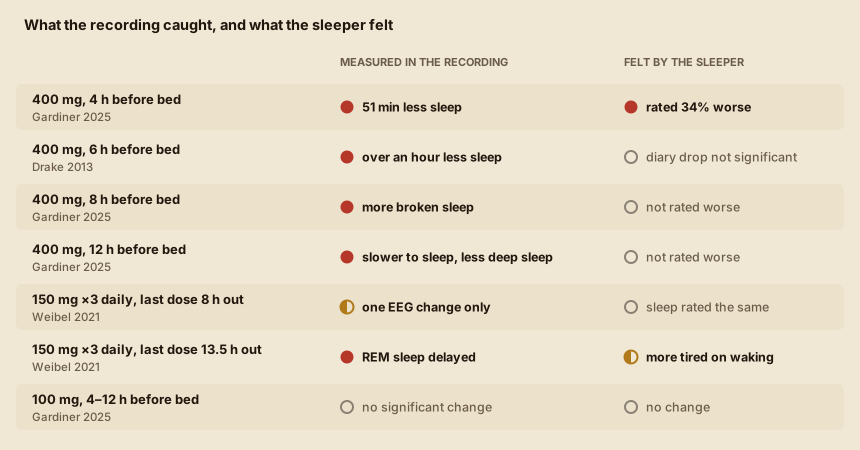
In a 2025 trial, men took a big dose of caffeine (400 mg) or a small one (100 mg) at different times before bed, then slept at home wired to a sleep recorder. When the big dose came twelve hours before bed, the recording showed they took longer to fall asleep and got less deep sleep. They didn't rate their sleep any worse. Only when it came four hours before bed did they notice. The small dose changed nothing either way.
Other studies found the same gap. In one, 400 mg six hours before bed cost more than an hour of recorded sleep, and people's own sleep diaries showed a smaller drop that could have been chance. In another, men who took caffeine three times a day rated their sleep as normal while the recordings showed their dream sleep arriving later. What they did notice was feeling more tired when they woke up.
The same coffee, four start times
If you can't feel it, the clock is your guide. Here is a 200 mg coffee taken at four different times, with bed at 11 p.m. every night. The bars show what the model says is still in you when the lights go out.
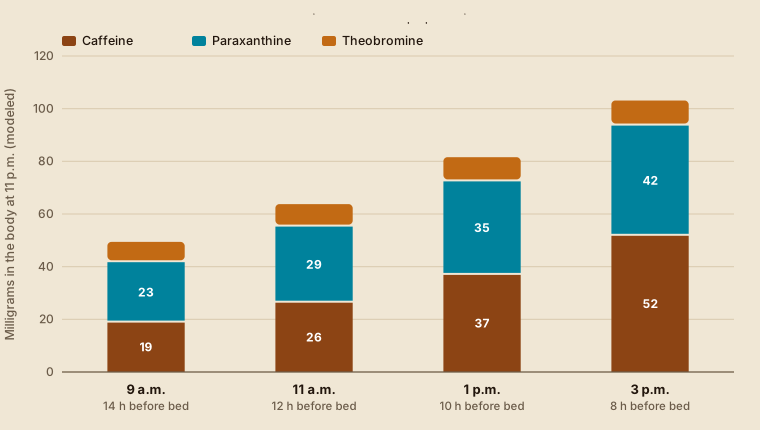
Moving the coffee from 11 a.m. to 1 p.m. takes you from about 64 mg at bedtime to about 82 mg. That's 28% more, from a two-hour shift, and you won't feel the difference at 11 p.m. either way.
Where the chocolate fits
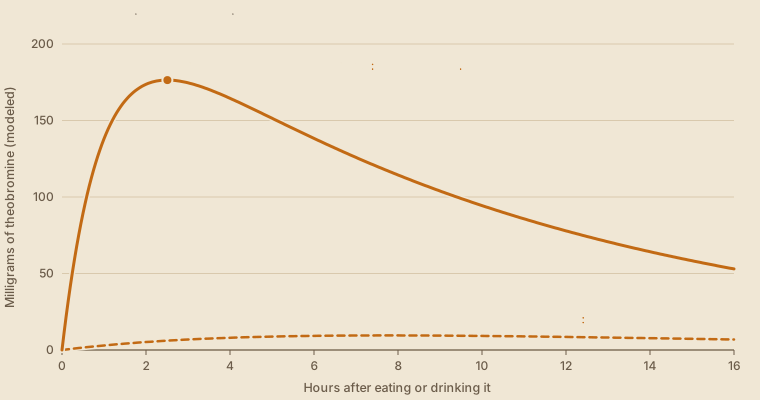
Chocolate's stimulant, theobromine, is even harder to feel. In one small study most people could learn to tell a big dose of it from a dummy pill, but it didn't make them feel more alert or energetic as a group, the way a smaller dose of caffeine did. A 28 g (one-ounce) serving of 70–85% dark chocolate carries about 225 mg of it, which peaks two to three hours after you eat it and takes about seven hours to fall by half. Your coffee makes only 8 or 9 mg by comparison.
So if evening chocolate costs you sleep, don't expect to feel it working first.
What to do this week
Go by the clock and by how you sleep, not by how the coffee feels. Move your last caffeine two hours earlier and keep it there for two weeks before you decide anything, including cutting the amount. If you have a watch or ring that tracks sleep, use it, and note how tired you feel when you wake up, since that's the one effect people in the studies noticed. Have dark chocolate at lunch rather than after dinner.
Health Canada's limit for healthy adults is 400 mg of caffeine a day, and 300 mg during pregnancy or breastfeeding.12 If you're pregnant or breastfeeding, take regular medication, or have a heart condition, the right amount and timing for you is a conversation with your doctor or pharmacist.
An afternoon coffee you can't feel at bedtime can still cost you sleep, so move it earlier.
Intermediate
The Unfelt Night
Our founder's question was whether a 1 p.m. coffee is really worse for sleep than the same coffee at 11 a.m. By 11 p.m. he couldn't feel either one, and the obvious test is to try both and notice which night was worse. The sleep trials say noticing is the weak link. Recordings pick up caffeine's effect on sleep from doses taken eight to twelve hours earlier, and the sleepers themselves mostly don't.
What the trials measured, and what sleepers reported
- Dose and timing, 2025: 23 men who normally drank under 300 mg a day took a placebo, 100 mg or 400 mg of caffeine 12, 8 or 4 hours before bed, with sleep recorded at home and a diary each morning. At 100 mg nothing changed, measured or felt. At 400 mg twelve hours out, sleep onset came 15.3 minutes later, more of the night went to light sleep and deep sleep fell by 20.6 minutes; eight hours out, sleep broke up more; four hours out, total sleep fell by 50.6 minutes. The men rated their sleep worse only at four hours, by 34%.1
- Timing, 2013: 12 adults took 400 mg at bedtime, three hours before or six hours before. A home EEG headband recorded more than an hour less sleep in every condition. At six hours, the sleep diaries showed a 41-minute drop that wasn't statistically clear. The headband's maker funded the study.2
- Daily caffeine, 2021: 20 men took 150 mg three times a day for ten days, the last dose eight hours before sleep. Sleep length, time to fall asleep, sleep stages and rated sleep quality were all unchanged; the only difference was a subtle change in the EEG during non-dream sleep.3 In a related study on the same regimen, with sleep starting 13.5 hours after the last dose, dream sleep arrived later, rated sleep was unchanged, and the men reported more trouble waking and more tiredness on waking.4
- A morning dose, 1995: 200 mg at 7:10 a.m. still reduced sleep efficiency and total sleep that night in nine men, with caffeine detectable in their saliva at an 11 p.m. bedtime.5
Close to bedtime, people feel it. Further out, the recording catches changes the sleeper doesn't, and "I slept fine" stops being evidence. The one thing people noticed from a distance was the morning after, which makes next-morning tiredness a better thing to track than your verdict on the night.
Eleven versus one
Because you won't feel the difference, it's worth knowing its size. The model gives the same 200 mg at 11 a.m. and 1 p.m. with bed at 11 p.m., using measured half-lives (caffeine 4.1 h, paraxanthine 3.1 h, theobromine 7.2 h) and the conversion rates measured in volunteers.67
| At 11 p.m. | Coffee at 11 a.m. | Coffee at 1 p.m. | Change |
|---|---|---|---|
| Caffeine | 26.3 mg | 36.9 mg | +40% |
| Paraxanthine | 28.9 mg | 35.5 mg | +23% |
| Theobromine | 8.5 mg | 9.2 mg | +8% |
| All three | 63.8 mg | 81.6 mg | +28% |
Two hours is about half of caffeine's half-life, so the later cup leaves 1.4 times the caffeine. Paraxanthine rises less because it's past its peak by then, and theobromine's curve is flat enough that two hours hardly moves it. Whether that extra 18 mg matters depends on dose and on you, which is what the trials above show and a two-week test can tell you.
Chocolate
USDA data for 70–85% dark chocolate give about 802 mg of theobromine and 80 mg of caffeine per 100 g, so a 28 g serving carries about 225 mg of theobromine and 22 mg of caffeine.8 After eating chocolate, blood theobromine peaks two to three hours later and falls by half in about seven hours.9 It's hard to feel. In seven people trained to tell drugs from a placebo, five learned to detect theobromine, at 100 to 560 mg, but 560 mg didn't raise the group's ratings of well-being, energy or alertness, while 178 mg of caffeine did.10 In 80 adults, 250 mg barely changed how people felt; 500 and 1,000 mg raised heart rate, and people tended to dislike them.11
Theobromine is barely felt and arrives in the evening at around 175 mg, so our founder's chocolate problem fits the pattern of the trials above: sleep registers what the sleeper doesn't.
A two-week test
- Fix the dose: same drink, same size, every day.
- Change only the time: last caffeine at 1 p.m. for a week, then 11 a.m. for a week, same bedtime throughout.
- Keep chocolate to lunchtime or earlier for the whole test.
- Measure rather than feel: use a watch or ring for time to fall asleep and wake-ups, and rate how tired you feel on waking from 0 to 10 before you look at the data. That morning rating is the one felt signal the studies found.
- Mark the confounds: hard training days, a bad night before, a stressful day. Compare like days with like, and drop the ones you can't match.
What to change first
Move the last cup before you shrink it. Two hours earlier cuts the bedtime caffeine and paraxanthine by about a quarter, and you won't miss it: by the afternoon a daily drinker feels little from the cup anyway (Part 1 covers why). Move evening chocolate to daytime. Leave the morning coffee alone.
Health Canada's limit for healthy adults is 400 mg of caffeine a day, and 300 mg during pregnancy or breastfeeding.12 If you're pregnant or breastfeeding, take regular medication, or have a heart condition, the right amount and timing for you is a conversation with your doctor or pharmacist.
Advanced
The Two-Hour Step
Take someone who suspects a 1 p.m. coffee costs them more sleep than an 11 a.m. one. The natural test is subjective: try both and judge the nights. The sleep literature says that test is badly powered. Across four studies, sleepers reported little or nothing of what their recordings showed unless the dose came within about four hours of bed, so the decision has to rest on exposure and on measured sleep. So the useful questions are how big the exposure difference is, which compounds carry it, and what the trials let us say about its effect.
What sleepers miss
| Study | Dose and timing | Measured | Felt |
|---|---|---|---|
| Gardiner 2025, n = 23 men1 | 400 mg, 12 h | Onset +15.3 min, more light sleep, N3 −20.6 min; TST −30 min (p = .06) | Quality not worse |
| 400 mg, 8 h | More fragmentation | Quality not worse | |
| 400 mg, 4 h | TST −50.6 min | Quality −34% (p = .006) | |
| 100 mg, 4–12 h | No significant effect | No significant effect | |
| Drake 2013, n = 122 | 400 mg, 6 h | TST −1.1 to −1.2 h (single-channel EEG device) | Diary −41 min (p = .08) |
| Weibel 2021, n = 20 men3 | 3 × 150 mg/day, last 8 h | Only NREM sigma power reduced | All rated domains unchanged |
| Weibel 20214 | Same, last 13.5 h | REM latency longer | Sleep ratings unchanged; more trouble waking, more tired on waking (p < .01) |
| Landolt 1995, n = 95 | 200 mg at 07:10 | Lower sleep efficiency and TST; salivary caffeine ~3 µmol/L at 23:00 | Not reported |
The measured changes that go unfelt are architectural: onset, deep sleep, fragmentation, REM timing and spectral power. A morning "how did you sleep" question is coarse enough to miss all of them. The one distal effect people did report was next-morning tiredness, which makes a waking-alertness rating the better self-test instrument.
Decomposing two hours
Same model as Part 1: one compartment, first-order kinetics, half-lives of 4.1, 3.1 and 7.2 h, fractional conversion 79.6% to paraxanthine and 10.8% to theobromine.67 A 200 mg dose, an 11 p.m. bedtime, twelve hours of clearance against ten:
The caffeine ratio is exact, 2^(2/4.1) = 1.40; paraxanthine rises by 1.23 because it's past its peak but not yet in formation-limited decay; theobromine rises by 1.08 because its curve is near its broad maximum. Under either alternative split, theobromine's share of the step stays under 5%. The absolute step barely depends on the person: holding the split and moving caffeine's half-life from 2.8 to 4.1 to 5.4 to 8 h gives steps of 16.3, 17.8, 17.7 and 16.0 mg, landing on floors of 45, 64, 80 and 104 mg.6
What the trials allow
Running two of the 2025 trial's conditions through the model gives this at lights-out:
| Trial condition | Caffeine | Paraxanthine | Theobromine | Measured | Felt |
|---|---|---|---|---|---|
| 100 mg, 4 h before bed | 50.9 mg | 22.8 mg | 4.0 mg | no effect | no effect |
| 400 mg, 12 h before bed | 52.6 mg | 57.8 mg | 17.1 mg | later onset, less deep sleep | no effect |
At lights-out the two conditions carry almost the same caffeine and lose it at the same rate through the night. They differ most in paraxanthine, by a factor of about 2.5, and neither was felt. That's a hypothesis rather than a finding: 400 mg could act through routes the model doesn't carry, including daytime effects on sleep pressure. But it's the most direct hint we found that the unfelt second wave matters for sleep, and it's cheap to test.
The chocolate route
Dark chocolate at 70–85% carries 802 mg theobromine and 80 mg caffeine per 100 g, so 28 g carries about 225 and 22 mg.8 After milk chocolate, blood theobromine peaked at 2–3 h with a half-life of 7.1 ± 2.1 h in six women.9 Modeled with k_a = 1.05 h⁻¹ (tuned to a 2.5-hour peak), a serving at 8 p.m. leaves about 175 mg at 11 p.m. Felt, theobromine is weak: five of seven trained participants learned to discriminate it at 100–560 mg, but 560 mg left group ratings of well-being, energy and alertness unchanged where 178 mg caffeine raised them,10 and in 80 adults 250 mg had no effect on heart rate and little on mood while 500–1,000 mg raised heart rate and were disliked.11 None of these studies measured sleep. An evening chocolate problem is therefore plausible, would be unfelt as stimulation, and rests on one person's crossover.
The threshold idea
The working model our founder landed on goes like this. Each person has a bedtime methylxanthine load above which their sleep degrades, whether or not they feel it. Evening chocolate, slow clearance or a big morning dose set the floor, and a later coffee adds a step of 16–18 mg of mostly caffeine and paraxanthine. No validated way exists to add milligrams of different methylxanthines into one sleep number, so the threshold is a working frame that nobody can yet put a number on.
Stated so it can fail, it's wrong if any of these turn up:
- Measured bedtime levels after 11 a.m. and 1 p.m. dosing in which theobromine accounts for a large share of the difference. The model says under 5%.
- A trial dosing paraxanthine alone to leave 40–60 mg at bedtime, with polysomnography, that finds no sleep effect where matched caffeine exposure does.
- A crossover of 200 mg at 11 a.m. against 1 p.m. that finds no difference in objective sleep or next-morning alertness in people who report timing sensitivity.
This is where the guidance stops. The model predicts what's in you, the trials show sleep responding to it below the level people notice, and nobody knows your threshold.
Health Canada's limit for healthy adults is 400 mg of caffeine a day, and 300 mg during pregnancy or breastfeeding.12 If you're pregnant or breastfeeding, take regular medication, or have a heart condition, the right amount and timing for you is a conversation with your doctor or pharmacist.
Part 1 · The Second Wave covers what a coffee feels like, how tolerance changes it, and why the feeling ends so long before the caffeine does.
Part 3 · Bottled Paraxanthine asks whether paraxanthine taken on its own feels different from caffeine, and what the trials actually measured.
Sources
- Gardiner CL, Weakley J, Burke LM, et al. Dose and timing effects of caffeine on subsequent sleep: a randomized clinical crossover trial. Sleep 2025;48(4):zsae230. 23 men, placebo or 100 or 400 mg at 12, 8 or 4 h before bed; in-home polysomnography and sleep diaries.
- Drake C, Roehrs T, Shambroom J, Roth T. Caffeine effects on sleep taken 0, 3, or 6 hours before going to bed. J Clin Sleep Med 2013;9(11):1195–1200. 12 adults, 400 mg; sleep measured with a single-channel home EEG device; funded by the device's maker.
- Weibel J, Lin YS, Landolt HP, et al. The impact of daily caffeine intake on nighttime sleep in young adult men. Sci Rep 2021;11:4668. 20 men, 3 × 150 mg a day for 10 days; sleep and its rating unchanged apart from reduced NREM sigma power.
- Weibel J, Lin YS, Landolt HP, et al. Regular caffeine intake delays REM sleep promotion and attenuates sleep quality in healthy men. J Biol Rhythms 2021;36(4):384–394. Delayed REM sleep; more trouble waking and more tiredness on waking.
- Landolt HP, Werth E, Borbély AA, Dijk DJ. Caffeine intake (200 mg) in the morning affects human sleep and EEG power spectra at night. Brain Res 1995;675(1–2):67–74. Nine men; 200 mg at 07:10 reduced sleep efficiency and total sleep that night.
- Lelo A, Birkett DJ, Robson RA, Miners JO. Comparative pharmacokinetics of caffeine and its primary demethylated metabolites paraxanthine, theobromine and theophylline in man. Br J Clin Pharmacol 1986;22(2):177–182. Six healthy non-smoking men given each compound separately; half-lives caffeine 4.1 ± 1.3 h, paraxanthine 3.1 ± 0.8 h, theobromine 7.2 ± 1.6 h, theophylline 6.2 ± 1.4 h.
- Lelo A, Miners JO, Robson RA, Birkett DJ. Quantitative assessment of caffeine partial clearances in man. Br J Clin Pharmacol 1986;22(2):183–186. Five volunteers at steady state; fractional conversion of caffeine to paraxanthine 79.6%, theobromine 10.8%, theophylline 3.7% (83.9%, 12.1% and 4.0% of the demethylation routes alone).
- USDA FoodData Central. Chocolate, dark, 70–85% cacao solids (FDC ID 170273). Theobromine 802 mg and caffeine 80 mg per 100 g.
- Resman BH, Blumenthal P, Jusko WJ. Breast milk distribution of theobromine from chocolate. J Pediatr 1977;91(3):477–480. Six women after 113 g of milk chocolate: blood theobromine peaked 2–3 h after eating; half-life 7.1 ± 2.1 h.
- Mumford GK, Evans SM, Kaminski BJ, et al. Discriminative stimulus and subjective effects of theobromine and caffeine in humans. Psychopharmacology 1994;115(1–2):1–8. Seven participants; theobromine detected by five at 100–560 mg; 560 mg left group ratings unchanged.
- Baggott MJ, Childs E, Hart AB, et al. Psychopharmacology of theobromine in healthy volunteers. Psychopharmacology 2013;228(1):109–118. 80 adults, 250, 500 and 1,000 mg theobromine against 200 mg caffeine and placebo; funded by Unilever and the NIH.
- Health Canada. Caffeine in foods. Maximum daily intake of 400 mg for healthy adults and 300 mg during pregnancy or breastfeeding.