The Caffeine Tail · Part 1 of 3
The Second Wave
Beginner
Most people judge a coffee by how it feels. Within half an hour you're sharper and more awake. A few hours later that's gone, and it feels as though the coffee has worn off. The feeling is real, and it's a poor guide to what's still in you. That gap is what this series is about.
We went looking into it because of chocolate. Our founder had noticed that chocolate in the evening kept him awake, and when he cut it out and then brought it back, the pattern held. That raised a question about his coffee. If evening chocolate could cost him sleep, what was his afternoon coffee still doing at bedtime, long after he'd stopped feeling it?
What a coffee feels like
Caffeine works fast. From a drink, it's at its highest in your blood about half an hour later, and in studies people can tell caffeine from a dummy pill within 10 to 30 minutes. Some people notice as little as 10 to 20 mg.
Around 100 mg, people report feeling more alert and energetic, in a better mood and less sleepy. More isn't better. From about 150 mg some people start to feel anxious, and at 450 to 500 mg most people who rarely drink caffeine feel anxious, tense and aware of their heartbeat.
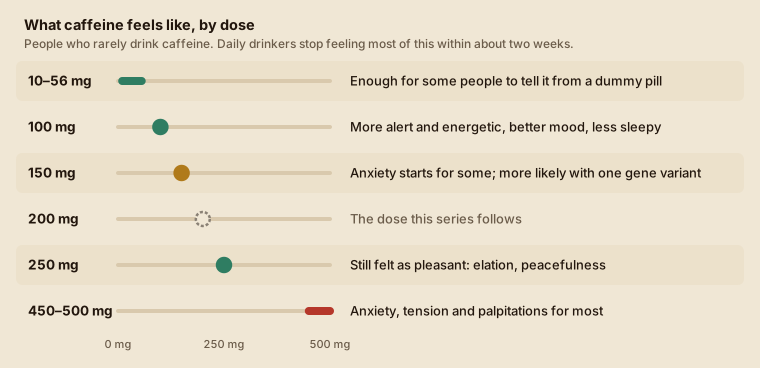
The lift is also short. In one study, a small dose gave people more energy half an hour later and left them more tired an hour and a half later.
If you drink it every day
For a daily coffee drinker, most of what the morning cup feels like is relief from the mild withdrawal that sets in overnight. After a night without it you're a bit sleepier and duller than you'd otherwise be, and the coffee brings you back to normal. In a study of nearly 380 people, that's all it did for regular drinkers: it restored them to where people who never drink caffeine already were. Within about two weeks of daily caffeine, most of the other feelings fade too.
What keeps going after the feeling fades
The feeling comes and goes in a couple of hours, but the caffeine takes much longer to leave. Your liver turns about four in five caffeine molecules into a second stimulant called paraxanthine. It builds up for about five hours, and by ten and a half hours after the cup there's more of it in you than caffeine.
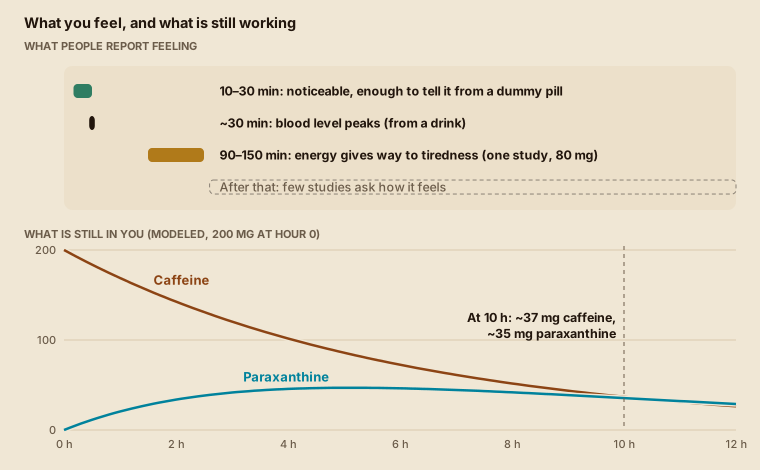
Paraxanthine is something you can feel. Taken on its own, our founder rated 50 mg of it at 3 out of 10 for felt strength, against 5.5 for 120 mg of caffeine. After a coffee, though, it arrives slowly, hours after the lift you notice, so it's easy not to think of it as part of the coffee at all.
Have a 200 mg coffee at 1 p.m. and by 11 p.m. you won't feel a thing. The model still has about 37 mg of caffeine and 35 mg of paraxanthine in you. Part 2 of this series is about what that does to your sleep, and whether you'd notice.
What to do tomorrow
Stop using the feeling as your sign that caffeine is gone. Decide when you want to be asleep and count back from there. If you drink coffee every day, the afternoon cup does less for how you feel than you'd think, because tolerance has taken most of its lift, and what it leaves in you at bedtime is the same as ever.
Health Canada's limit for healthy adults is 400 mg of caffeine a day, and 300 mg during pregnancy or breastfeeding.17 If you're pregnant or breastfeeding, take regular medication, or have a heart condition, the right amount and timing for you is a conversation with your doctor or pharmacist.
You feel a coffee for a couple of hours. It keeps working for most of a day.
Intermediate
The Felt Hours
How long a coffee lasts depends on whether you ask your body or your blood. Have 200 mg at 1 p.m. and you'll feel it by half past; by four you'd probably say it had worn off. Working from published clearance rates, about 37 mg of caffeine is still in you at 11 p.m., along with 35 mg of paraxanthine, a stimulant your liver makes out of caffeine. The felt part is the short one, tolerance shortens it further for daily drinkers, and the long part is what your sleep has to deal with.
What each dose feels like
The cleanest evidence on felt effects comes from people who rarely drink caffeine, because daily drinkers are tolerant and partly in withdrawal. In those studies:
- 10–56 mg: enough for some people to tell caffeine from a dummy pill. In a study of seven people, the lowest dose each could reliably detect was 10 mg for one, 18 mg for three and 56 mg for three, and they said they noticed it through changes in mood.1 In a second study of 15, the lowest dose that produced both detection and mood changes ranged from 18 to 100 mg.2
- 100 mg: higher ratings of alertness, energy, well-being, concentration and motivation for work, and lower ratings of sleepiness.1
- 150 mg: close to where anxiety starts. In 102 light users given 50, 150 or 450 mg, only 450 mg raised anxiety for the group, but people with one variant of the adenosine receptor gene were already more anxious at 150 mg.3
- 250 versus 500 mg: in 12 adults, 250 mg felt pleasant (elation, peacefulness). 500 mg added tension, nervousness, restlessness and palpitations, and helped performance less than 250 mg did.4
When you feel it, and when it stops
From a drink, caffeine reaches its highest blood level about 30 minutes later.5 People start telling it from a dummy pill within 10 to 30 minutes, which fits.12 The felt lift doesn't last long. In one study, 80 mg in water raised energy at 30 minutes and then left people more tired and more muddled at 90 and 150 minutes.6 Past the first few hours, few studies ask people how they feel at all.
What tolerance takes away
If you drink caffeine daily, your baseline changes. A review of the research concluded that the lift regular users feel is almost entirely the reversal of withdrawal.7 Two large studies bear that out. In 369 people split by how much caffeine they normally drank, going without made regular drinkers sleepier and slower, and caffeine brought them back; in non-drinkers and light drinkers it reduced sleepiness but added enough anxiety and jitteriness to cancel the benefit.8 In 379 people, caffeine never raised alertness above the level of non-drinkers on a dummy pill.9 And when 16 regular drinkers took 400 mg a day for two weeks, they became completely tolerant on seven of eight felt measures, with no net benefit over taking none.10
So for a daily drinker, the first cup mostly repairs the morning, and the afternoon cup adds little you can feel. What each cup leaves in your body doesn't shrink with tolerance.
What's still working
Your liver turns about four-fifths of each caffeine dose into paraxanthine and about a tenth into theobromine.12 Paraxanthine clears a little faster than caffeine (half-life 3.1 hours against 4.1), but it's made continuously as the caffeine breaks down, so its amount rises for about five hours and passes caffeine at about ten and a half.11
| Hours after 200 mg | What people report | Caffeine | Paraxanthine |
|---|---|---|---|
| 0.5 | Noticeable; blood level near its peak | 183.8 | 11.4 |
| 2 | Lift fading | 142.6 | 33.7 |
| 6 | Rarely asked | 72.5 | 46.3 |
| 10 | Rarely asked | 36.9 | 35.5 |
| 12 | Rarely asked | 26.3 | 28.9 |
Middle column from the studies above; the amounts are modeled (milligrams present), using measured half-lives and conversion rates.
Paraxanthine is a stimulant in its own right. Taken on its own, our founder rated 50 mg at 3 out of 10 for felt strength and 120 mg of caffeine at 5.5; one person, but consistent with small trials in which 200 mg improved attention and memory tests.16 Part 3 of this series covers how it feels as a supplement.
Your own numbers
People clear caffeine at very different speeds. In the half-life study it was 4.1 hours give or take 1.3, in six healthy young men.11 Genes, pregnancy, oral contraceptives, liver health, smoking and many medications move it, mostly through one liver enzyme, CYP1A2, which handles about 95% of caffeine.14 A slower enzyme stretches the whole tail. Your felt response varies too, with tolerance and with gene variants.
What to change first
Stop timing caffeine by feel. Pick your bedtime and count back, because by the time a coffee has stopped feeling like anything, most of it is still in you. If you drink daily, the cup worth protecting is the first one, which restores you from withdrawal. A late one adds little you'll feel and the same load at bedtime.
Health Canada's limit for healthy adults is 400 mg of caffeine a day, and 300 mg during pregnancy or breastfeeding.17 If you're pregnant or breastfeeding, take regular medication, or have a heart condition, the right amount and timing for you is a conversation with your doctor or pharmacist.
Advanced
Formation Against Clearance
The subjective effects of caffeine are fast, short and tolerance-prone. The pharmacology is slow, long and indifferent to tolerance. That mismatch is the whole problem with timing caffeine by feel: the signal people use to judge when a dose has "worn off" is gone hours before the drug and its active metabolite are.
The felt evidence, and its limits
| Question | What the studies found | Limits |
|---|---|---|
| Lowest felt dose | Individual discrimination thresholds of 10, 18 and 56 mg in abstaining users (n = 7), reported as mood changes;1 18–100 mg for discrimination plus mood change (n = 15).2 | Tiny samples; trained discrimination is more sensitive than casual noticing. |
| Pleasant range | 100 mg raised alertness, energy, well-being, concentration, work motivation and self-confidence and lowered sleepiness;1 250 mg felt pleasant (n = 12).4 | Abstaining users, so part of the effect is relief. |
| Anxiety | Only 450 mg raised group anxiety in 102 light users; 150 mg did in ADORA2A rs5751876 TT carriers.3 500 mg exceeded 250 mg on tension, nervousness, restlessness and palpitations and improved performance less.4 | Genotype moves the threshold; habitual users become tolerant to it.8 |
| Onset and duration | Plasma Tmax 29.8 ± 8.1 min from an oral solution;5 discrimination within 10–30 min;12 80 mg in water raised energy at 30 min and raised tiredness and confusion at 90 and 150 min.6 | Almost no study rates felt effects beyond four hours. |
| Tolerance | Complete tolerance on 7 of 8 subjective measures after two weeks at 400 mg/day, with no net benefit over placebo (n = 16);10 no alertness above non-consumers on placebo (n = 379);9 regular users restored from withdrawal, low users' gains offset by anxiety (n = 369).8 Review: effects in habitual users "almost wholly" withdrawal reversal.7 | Laboratory dosing schedules; real intake is less regular. |
What's missing is a felt time course that runs as long as the pharmacology. We found no study rating subjective alertness or jitteriness hourly for twelve hours after an ordinary dose.
The model behind the part you don't feel
One compartment, first-order kinetics, instantaneous absorption. For caffeine C, paraxanthine P and theobromine B, in milligrams:
dC/dt = −k_C·C
dP/dt = f_P·r·k_C·C − k_P·P
dB/dt = f_B·r·k_C·C − k_B·B

k = ln 2 / t½        r = 180.16 / 194.19 = 0.928
which gives P(t) = f_P·r·D · k_C/(k_P − k_C) · (e^(−k_C·t) − e^(−k_P·t)), the same form for B, and a peak at t_max = ln(k_P/k_C)/(k_P − k_C). Half-lives 4.1 ± 1.3 h (caffeine), 3.1 ± 0.8 h (paraxanthine) and 7.2 ± 1.6 h (theobromine), measured in the same six men;11 branch fractions 0.796 and 0.108, the whole-dose conversion measured at steady state in five volunteers.12 The demethylation-only shares (0.839, 0.121) and an in-vitro CYP1A2 profile (0.815, 0.108) shift bedtime totals by under 3 mg.1213
Caffeine's clock
Because paraxanthine clears faster than it's formed (k_P > k_C), its elimination becomes formation-limited after the peak: it falls at caffeine's rate, and P/C climbs toward f_P·r·k_C/(k_P − k_C) ≈ 2.3. That's why a single paraxanthine-to-caffeine ratio a few hours after a dose tracks caffeine clearance well enough (r typically above 0.85, 78 subjects) to serve as a CYP1A2 test.15 It also means paraxanthine's short half-life doesn't protect a slow metaboliser. Moving caffeine's half-life from 2.8 to 5.4 to 8 h changes the 10-hour total from 61 to 98 to 120 mg while paraxanthine barely moves (35, 34, 29 mg); the caffeine column is what swings.1114
Milligrams and feelings
The model predicts mass, and felt intensity isn't linear in mass: detection thresholds sit far below the doses that bring anxiety, and tolerance flattens the whole curve. There's no validated conversion between a milligram of caffeine, of paraxanthine and of theobromine, and this series doesn't invent one. The one direct comparison we have is our founder's own rating, not a trial: 50 mg of paraxanthine taken on its own felt like 3 out of 10, and 120 mg of caffeine felt like 5.5. Read linearly, which it shouldn't be, that's 0.060 felt points per milligram for paraxanthine against 0.046 for caffeine. It does show that paraxanthine, at a dose comparable to what a coffee leaves at bedtime, can be felt when it arrives all at once. Small sponsor-funded trials agree it's psychoactive: 200 mg improved several attention and memory measures in 13 adults.16
What would falsify it
Two predictions are checkable. Pharmacologically, timed saliva samples after a known dose should show paraxanthine peaking four to six hours in and overtaking caffeine by ten to twelve; if typical metabolisers don't show that, the parameters are wrong and every number here with them. Subjectively, a study rating felt alertness and jitteriness hourly for twelve hours against measured caffeine and paraxanthine would show whether the felt curve tracks caffeine alone, both compounds, or neither once tolerance is accounted for. If it tracks caffeine alone, the second wave matters for sleep, if at all, without ever being felt, and Part 2 is where that question gets tested.
Health Canada's limit for healthy adults is 400 mg of caffeine a day, and 300 mg during pregnancy or breastfeeding.17 If you're pregnant or breastfeeding, take regular medication, or have a heart condition, the right amount and timing for you is a conversation with your doctor or pharmacist.
Part 2 · The Bedtime Ladder is about what caffeine does to sleep without you feeling it, and what moving the last cup two hours earlier is worth.
Part 3 · Bottled Paraxanthine asks whether paraxanthine taken on its own feels different from caffeine, and what the trials actually measured.
Sources
- Griffiths RR, Evans SM, Heishman SJ, et al. Low-dose caffeine discrimination in humans. J Pharmacol Exp Ther 1990;252(3):970–978. Seven abstaining users; lowest detectable doses 10–56 mg; 100 mg raised alertness, energy, well-being and concentration and lowered sleepiness.
- Silverman K, Griffiths RR. Low-dose caffeine discrimination and self-reported mood effects in normal volunteers. J Exp Anal Behav 1992;57(1):91–107. 15 volunteers; lowest dose producing both discrimination and mood effects 18–100 mg.
- Childs E, Hohoff C, Deckert J, et al. Association between ADORA2A and DRD2 polymorphisms and caffeine-induced anxiety. Neuropsychopharmacology 2008;33(12):2791–2800. 102 light users given 0, 50, 150 and 450 mg; only 450 mg raised group anxiety.
- Kaplan GB, Greenblatt DJ, Ehrenberg BL, et al. Dose-dependent pharmacokinetics and psychomotor effects of caffeine in humans. J Clin Pharmacol 1997;37(8):693–703. 12 adults; 250 mg felt pleasant; 500 mg added tension, nervousness and palpitations.
- Blanchard J, Sawers SJ. The absolute bioavailability of caffeine in man. Eur J Clin Pharmacol 1983;24(1):93–98. Peak plasma level 29.8 ± 8.1 min after an oral solution.
- Young HA, Benton D. Caffeine can decrease subjective energy depending on the vehicle with which it is consumed and when it is measured. Psychopharmacology 2013;228(2):243–254. 80 mg in water raised energy at 30 min and tiredness at 90 and 150 min.
- James JE, Rogers PJ. Effects of caffeine on performance and mood: withdrawal reversal is the most plausible explanation. Psychopharmacology 2005;182(1):1–8. Review.
- Rogers PJ, Heatherley SV, Mullings EL, Smith JE. Faster but not smarter: effects of caffeine and caffeine withdrawal on alertness and performance. Psychopharmacology 2013;226(2):229–240. 369 participants split by habitual intake.
- Rogers PJ, Hohoff C, Heatherley SV, et al. Association of the anxiogenic and alerting effects of caffeine with ADORA2A and ADORA1 polymorphisms and habitual level of caffeine consumption. Neuropsychopharmacology 2010;35(9):1973–1983. 379 participants; caffeine did not raise alertness above non-consumers on placebo.
- Sigmon SC, Herning RI, Better W, et al. Caffeine withdrawal, acute effects, tolerance, and absence of net beneficial effects of chronic administration. Psychopharmacology 2009;204(4):573–585. 16 regular users; complete tolerance on 7 of 8 subjective measures after two weeks at 400 mg/day.
- Lelo A, Birkett DJ, Robson RA, Miners JO. Comparative pharmacokinetics of caffeine and its primary demethylated metabolites paraxanthine, theobromine and theophylline in man. Br J Clin Pharmacol 1986;22(2):177–182. Six healthy non-smoking men given each compound separately; half-lives caffeine 4.1 ± 1.3 h, paraxanthine 3.1 ± 0.8 h, theobromine 7.2 ± 1.6 h, theophylline 6.2 ± 1.4 h.
- Lelo A, Miners JO, Robson RA, Birkett DJ. Quantitative assessment of caffeine partial clearances in man. Br J Clin Pharmacol 1986;22(2):183–186. Five volunteers at steady state; fractional conversion of caffeine to paraxanthine 79.6%, theobromine 10.8%, theophylline 3.7% (83.9%, 12.1% and 4.0% of the demethylation routes alone).
- Gu L, Gonzalez FJ, Kalow W, Tang BK. Biotransformation of caffeine, paraxanthine, theobromine and theophylline by cDNA-expressed human CYP1A2 and CYP2E1. Pharmacogenetics 1992;2(2):73–77. Cell-based enzyme study, no volunteers: CYP1A2 converts caffeine to paraxanthine 81.5%, theobromine 10.8%, theophylline 5.4%, and also metabolises paraxanthine.
- Nehlig A. Interindividual differences in caffeine metabolism and factors driving caffeine consumption. Pharmacol Rev 2018;70(2):384–411. CYP1A2 metabolises about 95% of ingested caffeine; reviews the genetic, hormonal, dietary, smoking and drug factors that change clearance.
- Fuhr U, Rost KL. Simple and reliable CYP1A2 phenotyping by the paraxanthine/caffeine ratio in plasma and in saliva. Pharmacogenetics 1994;4(3):109–116. 78 subjects; the ratio 3–7 h after a dose tracks systemic caffeine clearance, with correlations typically above 0.85.
- Yoo C, Xing D, Gonzalez D, et al. Acute paraxanthine ingestion improves cognition and short-term memory and helps sustain attention in a double-blind, placebo-controlled, crossover trial. Nutrients 2021;13(11):3980. 13 adults, 200 mg; funded by the ingredient's maker, with three of its principals among the authors.
- Health Canada. Caffeine in foods. Maximum daily intake of 400 mg for healthy adults and 300 mg during pregnancy or breastfeeding.