The 35 °C Tax: The Stress Debt You Sign for at Goal Pace
At 35 °C, holding your goal pace doesn't cost you at 5k — it lends you the performance. You feel fine because the bill hasn't arrived. This is the ledger of what you're quietly borrowing: blood volume, heart rate, and the reserves you can't feel yourself spending.
The bill hasn't arrived — that's the trap 35 °C, goal pace, and it feels easy through 5k. It feels easy because you're borrowing, not paying. The interest is compounding the whole time.
Here's the thing about running your cool-weather goal pace on a 35 °C day: for the first twenty minutes, nothing feels wrong. The legs are fresh, the pace clicks off, the watch says you're on target. So the story you tell yourself is that the heat is a problem for later — something you'll deal with if and when it shows up.
It's already here. It showed up in the first kilometre. You just can't feel it yet, because what the heat does early isn't slow you down — it opens a line of credit. Every minute at goal pace, you draw a little more from reserves you didn't know you were spending: circulating blood volume, cardiac headroom, the blood supply to your gut and kidneys, and the few degrees of core-temperature space between you and the point where your brain simply takes the pace away. This is a companion to our main Heat, Humidity & Weight guide — a closer look at exactly what gets borrowed, and why the loan always gets called.
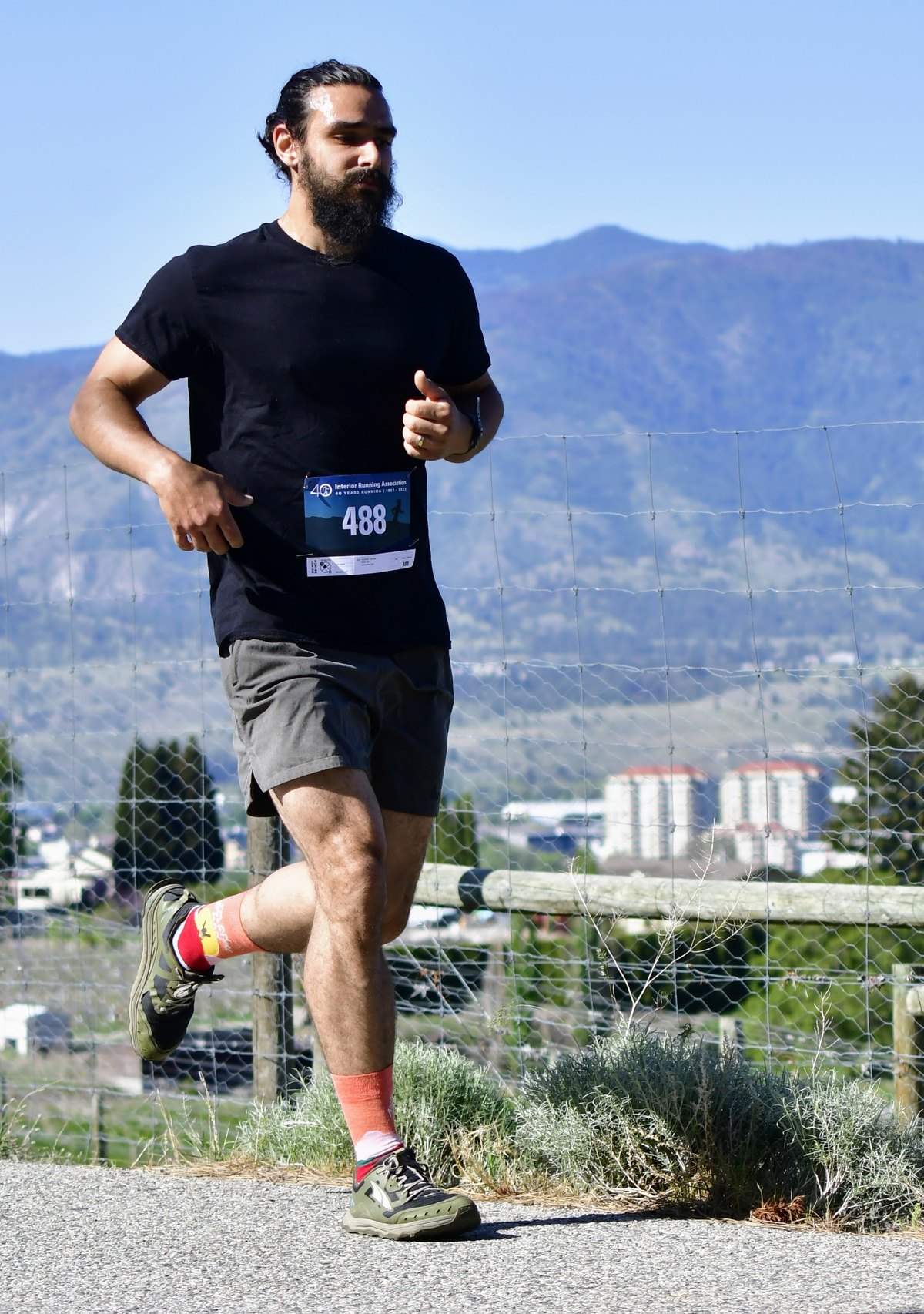
What "holding goal pace" actually spends
1. Why 35 °C is different — the tl;dr
This guide is about racing 5 km and up — the endurance distances where heat has time to pile up. Running already turns you into a furnace: working muscle drives your metabolic rate to 5–15× resting, and 70–100% of that energy leaves as heat2 that has to escape to keep your core stable. In the cool that's easy — the air is far colder than your skin, so heat pours off. At 35 °C the air is nearly as warm as your skin, the gradient that carries heat away has almost collapsed, and evaporating sweat becomes essentially your only exit. Everything below is what your cardiovascular system does to keep that one exit open — and what it quietly borrows to do it.
2. Distance changes everything: farther in the heat costs more
Heat and distance multiply. The longer you're out there, the more heat you bank and the less reserve you keep to shed it — so the same 35 °C that trims a few percent off a 5k can gut a marathon and outright end a 50k.7 Flip it around and the rule inverts: for a short, explosive effort, warmth is an asset. Ten degrees is cold for a 500 m — the muscle's too cool to fire fast — while 25–30 °C is close to ideal, and there's no time to overheat. The best temperature isn't fixed; it slides with the distance.8 Drag the distance slider below to reshape the curve, then drag along it to read the penalty at any temperature.
Drag the dot
How much does the temperature cost you?
Air temperature only — no pace, weight, or finish time. Drag along the curve to see roughly how much a day taxes distance-running pace, indexed to a cool-weather optimum: nearly flat when it's cool, steepening fast once it's hot. Temperature is just one dial, though. Humidity decides whether your sweat can actually evaporate; wind can hand some cooling back. You're an integrated system reacting to all of it at once — even putting one foot in front of the other isn't clockwork, it's a body continuously negotiating with its environment. Treat the curve as the shape of the story, not a promise.
Reading: at 35 °C, expect roughly 10% slower than your cool-weather pace.
Generalized illustration — the asymmetric-U shape and the distance-dependent optimum come from the marathon and heat literature (El Helou 20128; World Athletics heat data7). Your real number also depends on humidity, acclimatization, body size, and pace — the Total Heat Load calculator folds those in.
Debt #1 — Blood volume: one pump, two jobs, not enough to go around
To dump heat, your body pushes blood to the skin so it can offload into the sweat and the air. Under heat stress, skin blood flow can climb toward 7 L/min at full vasodilation2 — an enormous fraction of your entire circulation rerouted to the surface. But your legs need that same blood to deliver oxygen. You have one pump and one tank, now serving two masters.
It gets worse mechanically. The veins in dilated skin are compliant — they balloon and pool blood at the surface instead of returning it promptly to the heart. Less blood comes back, so the heart fills with less, so it ejects less per beat. On top of that you're losing the tank: a runner commonly sweats around 1 L/h (Alberto Salazar famously hit 3.7 L/h at the 1984 Olympic Marathon)2, and every unreplaced litre drops your plasma volume and thickens what's left. Falling central blood volume plus pooled skin blood plus a shrinking, more concentrated tank all converge on the same casualty: stroke volume, the amount of blood you move per heartbeat. That's the principal on the loan. Everything else is interest.
Debt #2 — Heart rate: cardiac drift is the interest payment
Your body has a hard rule: cardiac output — total blood moved per minute — must be defended. It's simple arithmetic, Q = HR × SV. If stroke volume (SV) is falling, then heart rate (HR) has to rise to keep the product (Q) up. So it does, relentlessly, at the same pace and the same effort. This is cardiovascular drift, and it is the single most honest read on the debt because you can watch it happen live on your watch.
A concrete shape of it: a runner holding a steady 8:00/mile can see heart rate climb from ~145 bpm in the first miles to ~166 bpm1 later on — no change in pace, no hill, nothing but time and heat. The magnitude tracks how much fluid you're losing: matching your sweat rate with fluid holds drift to about 5%; taking in nothing lets it run to ~10%; normal drift over a long, hot effort reaches up to ~15% — enough to shove you up a full heart-rate zone while the pace on your watch never moves. The number on the ground hasn't changed. The cost of producing it has.
Debt #3 — The hidden creditors: your gut and kidneys fund the loan
Here's the part almost nobody feels until it's a crisis. When skin and muscle both demand blood the heart can't fully supply, the body raids the accounts it deems non-essential mid-race: it clamps down blood flow to the gut (splanchnic) and kidneys2 to free up circulation for cooling and locomotion. This shunt is additive — it deepens with both harder effort and higher temperature, so at 35 °C and goal pace you're squeezing both dials at once.
Those cuts are the "other stress debt" that the heart-rate number hides:
- The gut: a starved gut absorbs poorly and rebels — the nausea, sloshing, and "can't take a gel" that ambush hot-day runners aren't a weak stomach, they're a gut that's had its blood supply repossessed to pay for cooling. It also frays the gut lining, letting contents leak into circulation and adding a low-grade inflammatory load on top of everything else.
- The kidneys: asked to conserve every drop of a shrinking blood volume, they slash output and concentrate hard. Do this dehydrated, hot, and hours-long often enough and it's genuine strain, not just dark urine at the finish.
None of this shows up as a slower pace at 5k. It shows up as a body that has fewer and fewer places left to borrow from.
Debt #4 — Core-temperature headroom: the loan the brain calls
Every kilometre at goal pace you can't fully cool, your core temperature ratchets up — and you're spending down a fixed, non-negotiable reserve. Somewhere around 39–40 °C core3, an anticipatory governor in the brain steps in and involuntarily cuts your power output to keep you from cooking. Lars Nybo's group at the University of Copenhagen showed this is largely a central fatigue mechanism: as core temperature climbs toward 40 °C, the brain proactively dials down the neural drive it sends to the working muscles — reducing heat production to protect itself.2 The legs aren't failing; the signal to them is being throttled at the source. This is the moment the whole balance comes due: the pace falls off a cliff, and it feels like total system failure because it is one — the physiology imposing the slowdown you declined to take voluntarily.
And your ceiling was already lower than you think. Severe heat measurably drops the top end — maximal oxygen uptake falls and maximum cardiac output can be roughly 1.2 L/min lower2 in the heat, because so much of the pump's capacity is committed to cooling instead of running. So you're spending a reserve that heat has also made smaller. The two curves — rising demand, shrinking supply — meet, and when they do, the governor doesn't negotiate.
Debt #5 — Your red line moves toward you (the metabolic shift)
Heat doesn't just tax the plumbing — it moves the physiological threshold you're racing against. Brighton's Environmental Extremes Lab (Neil Maxwell, Carl James, Ashley Willmott) mapped this directly: run at 32 °C and your lactate threshold, VO₂max, and running economy all degrade together.5 The practical consequence is blunt — lactate starts accumulating at slower speeds than it does in the cool, so the "red line" you normally cross at, say, threshold pace now sits at a pace well below it. You can be running an easy effort on paper and be metabolically deep in the hurt, because the day quietly walked your threshold back toward you. That's debt you never see on the watch — only in your legs later.
Debt #6 — The perceptual tax (it feels harder before it is harder)
There's a final creditor that shapes every decision you make mid-race: perception. In the heat your Rating of Perceived Exertion climbs faster than the pace or even the physiology strictly warrants — an identical pace simply feels drastically harder, and it feels that way well before any real failure point. That's not weakness; it's an early-warning tax the body levies to make you back off. It's also double-edged: if you're mentally committed to "hold goal pace no matter what," you override the warning and spend the other five debts faster. Notably, Willmott and colleagues (2019)6 showed that heat acclimation blunts exactly this — it attenuates the inflated sensations of fatigue during exercise-heat stress, which is a large part of why acclimatized runners hold pace in conditions that wreck the unadapted.
The debt, kilometre by kilometre
What "it feels fine" is actually hiding, at 35 °C and unadjusted goal pace:
| Stage | What you feel | What's actually accruing |
|---|---|---|
| 0–5k | Easy. On pace. "The heat's fine." | Skin vasodilation begins; blood starts pooling at the surface; plasma volume already trending down with sweat loss. The credit line opens. |
| 5–15k | Still on pace, but the effort and the RPE are creeping up, HR "a little high." | Stroke volume falling; HR drifting +5–10% to defend output; gut & kidney blood flow being clamped; lactate rising at a pace that's normally easy; core temp climbing steadily. |
| 15k → the wall | Same pace now costs everything; RPE maxed; maybe nausea; HR "in a place it shouldn't be." | Drift toward +15%; threshold has walked back below race pace; core temp nearing 39–40 °C; central drive to the muscles being throttled. Balance due. |
| The blow-up | Legs won't respond; forced walk / survival shuffle. | The governor calls the loan and repossesses your pace. You repay the whole debt at once — plus interest. |
Illustrative timeline; the exact kilometres shift with fitness, acclimatization, hydration, body size, and the day. The sequence is what's reliable — the cost is always front-loaded invisibly and back-loaded painfully.
How to not sign the loan
You can't out-tough a collapsing blood volume — but you can decline to borrow against it in the first place. Three moves, in order of leverage:
- Run the adjusted pace from the gun. The heat penalty isn't a late-race cushion to spend — it's a discount you take on step one. Put temperature, humidity, and your weight into the Total Heat Load calculator and start at that pace, even while it feels absurdly easy. Feeling like you're holding back is the correct sensation; it means you're paying cash, not credit.
- Defend the tank: fluid and sodium. Matching sweat losses cuts cardiac drift roughly in half (~10% → ~5%), which directly protects stroke volume. But water alone dilutes you — you need sodium to actually hold the fluid in circulation. Steph's simple fuel recipe has the amounts.
- Bank real reserves in advance. The one intervention that raises your credit limit instead of spending it: 10–14 days of heat acclimatization expands plasma volume ~10–12%10 in the first week — literally more blood in the tank, so stroke volume holds, drift shrinks, and the same pace costs less. Time your last heat session a few days out so you keep the gains.
- Cool from the outside — water over the head and neck, shade, light and loose clothing — to slow the core-temperature spend directly.
Who actually measures this — and what they agree on
None of the above is folk wisdom. The "stress debt" model rests on decades of controlled work from a handful of environmental-physiology groups who put runners in the heat and measured what breaks, in what order. When you decide your hot-day pace, these are the people whose data you're really trusting:
| Group | What their data established |
|---|---|
| Racinais & Périard Aspetar (Qatar) · UC-RISE (Australia) | Led the international consensus recommendations on training and competing in the heat (2015).4 Their data shows the intersection of rising core temperature and dehydration forces an integrated behavioural response — the runner lowers pace to head off thermal injury. |
| Neil Maxwell — Environmental Extremes Lab University of Brighton (UK) | With Carl James and Ashley Willmott, produced the granular data on how heat dismantles performance: at ~32 °C, lactate threshold, VO₂max, and running economy all degrade (James et al., 20175), and repeated heat bouts accumulate as general and physical fatigue (Willmott et al., 20196). |
| Lars Nybo & team University of Copenhagen (Denmark) | The authority on hyperthermia and the brain. Showed heat's performance hit is largely central: as core nears 40 °C, the brain reduces neuromuscular drive to limit heat production.2 Debt #4, measured. |
| Douglas Casa — Korey Stringer Institute University of Connecticut (USA) | Massive real-world datasets on road racers, marathoners and ultrarunners — fluid-loss metrics, the humidity-driven collapse of sweat evaporation, and the threshold where heat strain crosses from performance-killer to medical emergency (exertional heat stroke).9 |
| Michael Sawka & Samuel Cheuvront formerly USARIEM (US Army) | The gold-standard foundational data used in military and athletic settings alike — the near-lockstep relationship between percent dehydration, elevated skin/core temperature, and the drop in absolute aerobic performance.13 |
Their collective picture is the one this note is built on: a civil war for blood flow (muscle vs. skin), resolved by cardiovascular drift (falling stroke volume, rising heart rate), a metabolic shift (lactate earlier, red line closer), and a perceptual tax (RPE up before failure) — every strand of it pulling the same direction: the honest pace on a hot day is slower than the one on your training plan.
Sources and guardrails
- Coyle & González-Alonso (2001), Exercise and Sport Sciences Reviews — Cardiovascular drift during prolonged exercise: falling stroke volume, rising heart rate, and the modulating role of hydration.
- Nybo, Rasmussen & Sawka (2014), Comprehensive Physiology — Performance in the heat: physiological factors of importance for hyperthermia-induced fatigue (skin blood flow, cardiovascular strain, reduced cardiac output and VO₂max, and central fatigue).
- Pacing and negative-split physiology review (2025), PMC — conservative starts, cardiovascular drift, and the anticipatory core-temperature governor (~39–40 °C).
- Racinais, Périard, Nybo, Sawka et al. (2015), Scandinavian Journal of Medicine & Science in Sports — Consensus recommendations on training and competing in the heat.
- James, Willmott, Gibson, Flouris & Maxwell et al. (2017), Temperature — Defining the determinants of endurance running performance in the heat (lactate threshold, VO₂max and economy degrade at ~32 °C).
- Willmott, Hayes, James, Gibson & Maxwell (2019), Temperature — Heat acclimation attenuates the increased sensations of fatigue during acute exercise-heat stress (the perceptual tax, and how acclimation blunts it).
- Racinais & Oksa (2010), Scandinavian Journal of Medicine & Science in Sports — Temperature and neuromuscular function: warm muscle raises short-duration/explosive performance (~2–5% per 1 °C) while hyperthermia impairs endurance — why the optimal temperature slides with distance.
- El Helou et al. (2012), PLoS ONE — Impact of environmental parameters on marathon running performance (n = 1,791,972): an optimal temperature (~7–12 °C for the marathon) with a quadratic penalty above it.
- Casa, DeMartini, Sawka et al. (2015), Journal of Athletic Training — NATA Position Statement: Exertional Heat Illnesses (real-world heat-strain data and the threshold from performance-killer to medical emergency).
- Périard, Racinais & Sawka (2015), Scandinavian Journal of Medicine & Science in Sports — Adaptations and mechanisms of human heat acclimation: the 10–14 day timeline, ~10–12% plasma-volume expansion, and sweat adaptations.
- Steph Brown PT — beginner run fueling & gut training (the sodium + carbohydrate recipe referenced above).
- Brown Family Sports — Heat, Humidity & Weight: The Case for Actually Running Slower (the full guide this note extends).
- Sawka, Burke, Eichner, Maughan, Montain & Stachenfeld (2007), ACSM Position Stand, Medicine & Science in Sports & Exercise — Exercise and Fluid Replacement: the dehydration ↔ core-temperature ↔ aerobic-performance relationship.
Guardrails: heat and dehydration can be dangerous. Chills, goosebumps, stopping sweating, dizziness, or confusion in the heat mean stop and seek medical help — that is not toughness territory. Nothing here is medical advice.