Heat, Humidity & Weight: The Case for Actually Running Slower
On a hot, humid day your goal pace is a trap. Not because you're unfit — because physics changed the race. Here's the number, the split discipline, and the science, for beginners, racers, and physiology nerds.
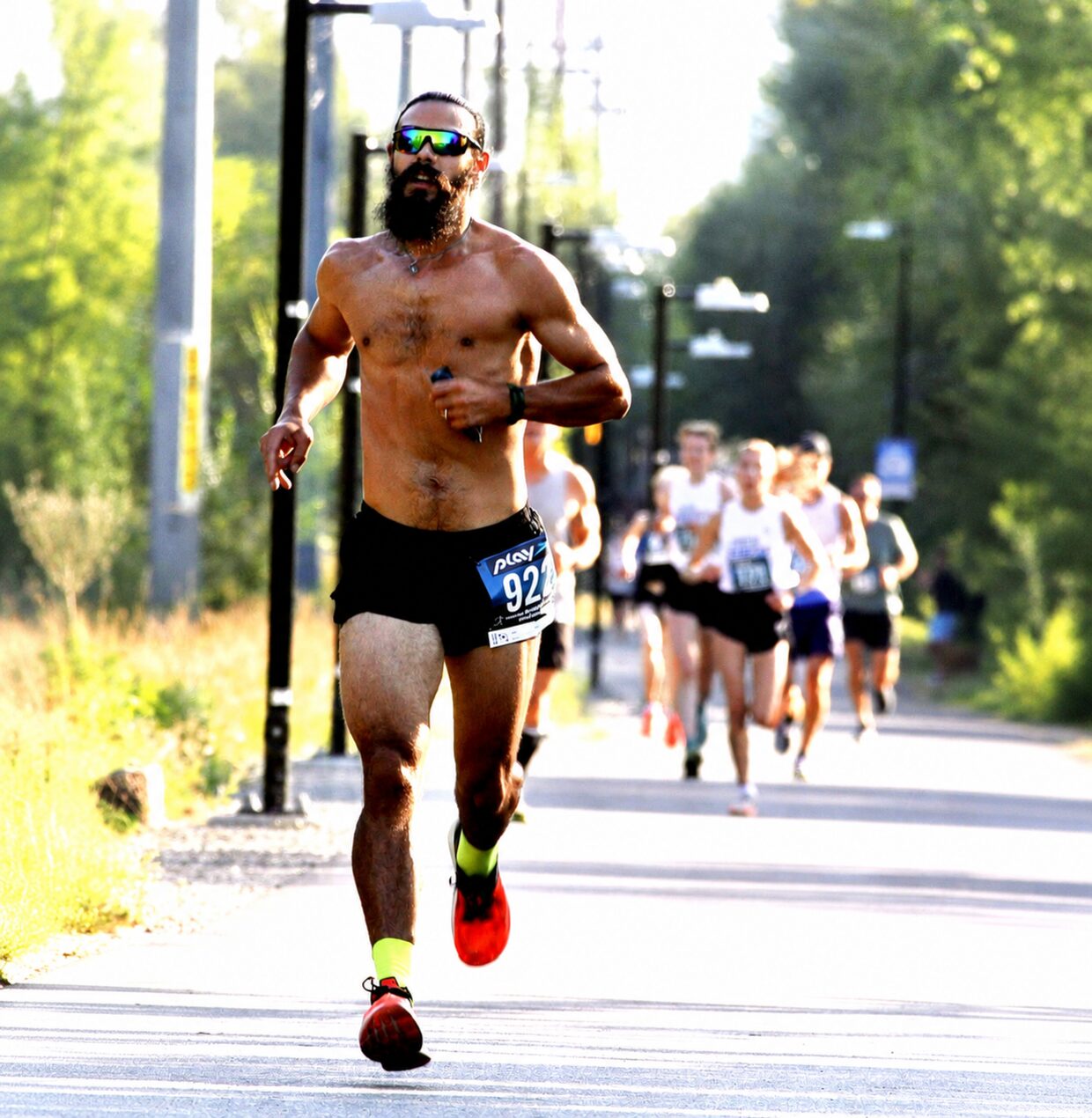
The halfway blow-up nobody plans for Same fitness, same goal, hot day — and the wheels come off at 15k. It isn't weakness. It's a pacing error baked in at the start line.
You trained for months. You know your goal pace in your sleep. The gun goes off and it feels easy, so you run it — right on target through 5k, still on target through 10k. Then somewhere past halfway the same pace starts costing everything, your heart rate is in a place it has no business being, and the last quarter turns into a survival shuffle.
Everyone blames themselves. Almost nobody blames the decision they made in the first mile: running a cool-weather goal pace on a warm, humid day. The heat didn't slow you at 5k. It was filling up a tank the whole time, and it presented the bill late. This guide is about not signing up for that bill.
The full guide, by level
Beginner level
It's Hotter Than the Number Says. Start Slower.
Why it feels worse than the thermometer
Your body has one main way to cool itself while running: sweating, and letting that sweat evaporate. Evaporation is what actually pulls heat off your skin. When the air is already full of moisture — a humid day — your sweat can't evaporate. It just drips. You're losing water and salt but getting almost none of the cooling. So the heat you're producing has nowhere to go, and your core temperature climbs.
That's why a 28 °C (82 °F) humid morning can feel like 32 °C+ to a running body, while a dry desert 32 °C can feel easier. The number on your phone is only half the story. Humidity is the other half — and often the bigger half.
The mistake almost everyone makes
Heat is cumulative. It builds through the whole run. Early on, at goal pace, you feel fine — so you bank a little time, thinking you'll need the cushion later. But your heart rate is quietly creeping up for that same pace (more on that below), and your core temp is rising. What felt comfortable at 5k is near-maximal by 15k. Then it falls apart, and the "cushion" you banked costs you triple to pay back.
The fix is boring and it works: slow down before you have to. Start at a pace that feels almost too gentle. In the heat, that gentle start is what lets you keep running instead of walking the last stretch.
Run your goal
Ease off a little
Clear slow-down
Race the day, not the clock
Survive & be safe
Humidity shifts you to the right even when the temperature looks mild. The hotter and stickier it is, the more you start by feel and let the finish time be whatever it is.
Your race-day checklist
- Get your number. Put the temperature, humidity, and your weight into the Total Heat Load calculator and use the pace it gives you.
- Start slow, finish strong. Aim to run the second half as fast or faster than the first (an "even" or "negative" split).
- Drink to thirst. Sip when you're thirsty. Don't force huge amounts, don't ignore it.
- Replace salt, not just water. Heat means heavy, salty sweating — and plain water alone can leave you bloated and flat. Put sodium in your drink. Stephanie's simple fuel recipe has the amounts.
- Cool from the outside. Pour water over your head and neck, take shade, wear light, loose, pale clothing.
- Respect the warning signs. Chills, goosebumps, stopping sweating, dizziness, or confusion in the heat mean stop. That's not toughness territory — that's medical.
Intermediate level
Working Ranges, Split Discipline & a Two-Week Plan
Once you accept the slow-down, the questions become: how much, and how do I actually execute it? Here are workable ranges and a repeatable process.
How much slower? Anchor on the optimum
The fastest distance running happens in a surprisingly cool window — roughly 7–12 °C (45–54 °F). That's colder than most runners assume. As it warms above that, pace degrades on an accelerating curve. In the largest study ever done on this — 1.79 million marathon finishers across six big-city marathons — air temperature was the single most influential weather variable, and the penalty grows faster the further you get from the optimum.
Ballpark magnitudes for the effort you can hold, indexed to heat stress: elite men lose about 1.7% at cool conditions rising to ~4.5% as it gets genuinely hot; women and — importantly — slower runners lose proportionally more. If you're a mid-pack marathoner, assume your penalty is bigger than the elite headline numbers, not smaller.
Fold in humidity: think dew point, not just temperature
Relative humidity is a slippery number because it depends on temperature. Dew point is a cleaner read on how much moisture is actually in the air — and how hard it'll be to cool. A common, practical shortcut is the temperature + dew point sum (shown in °C, with °F in brackets): the higher the sum, the bigger the pace hit.
| Temp + Dew Point sum — °C (°F) | Feel | Rough pace penalty |
|---|---|---|
| ≤ 20 (≤ 100 °F) | Ideal | ~0% |
| 26–31 (110–120 °F) | Noticeable | ~0.5–1.0% |
| 37–42 (130–140 °F) | Hard | ~2–3% |
| 48–53 (150–160 °F) | Brutal | ~4.5–6% |
| 59–64 (170–180 °F) | Dangerous | ~8–10% |
Practitioner "temp + dew point" table, consistent with the peer-reviewed magnitudes. Our Total Heat Load calculator does this more precisely, converting temperature + humidity + wind + sun into one "feels-like running temperature."
The split that survives heat
Heat punishes the positive split (starting fast, fading) more than any other pacing pattern. Because heat load accumulates, the back half is where it bites. The prescription is even or slightly negative splits: run the first third genuinely conservatively — a pace that feels like you're holding back — so you still have a cooling and cardiovascular reserve when everyone around you is unravelling after 30k.
Acclimatize: the highest-leverage two weeks
You can earn a big chunk of the heat penalty back by adapting to it deliberately. 10–14 days of repeated heat exposure (roughly 60–90 minutes a day at an elevated core temperature — easy running in the heat counts) drives real changes:
- Plasma volume expands ~10–12% within the first week → your heart doesn't have to work as hard, and heart rate at a given pace drops.
- You sweat earlier, more, and with less salt by the end of two weeks → better evaporative cooling and fewer electrolyte problems.
- Net effect: endurance in the heat improves on the order of ~5–15%, and the same pace simply feels easier.
Time it so the last heat session is a few days before the race. The plasma-volume gains are the fastest to arrive and the fastest to fade, so don't take a long, cool taper right before a hot race and lose them.
Salt matters more than water
In the heat you don't just lose water — you lose a lot of sodium, and it's the sodium that lets your body hold onto the fluid you drink and keep your muscles firing. Drink plain water alone on a hot, sweaty day and you can dilute yourself: bloated, flat, and — in the worst case — at real medical risk (hyponatremia). The fix is simple: put salt in your bottle. How much depends on how hard and salty you sweat, but a properly salted homemade mix beats plain water every time.
Racing weight, done sanely
Carrying less non-functional weight helps twice on a hot day: it's less mass to move (a power-to-weight gain) and less mass generating heat you then have to shed. As a rule of thumb, roughly 1% of body-mass lost ≈ ~1% faster pace — Jack Daniels' familiar "about two seconds per mile per pound." The total time you save grows with race distance simply because the race is longer.
A repeatable hot-race routine
- Two weeks out: start deliberate heat exposure, most days.
- Race week: check the forecast temp, humidity, wind, and sun.
- Race morning: run it through the Total calculator → get your adjusted pace and finish.
- First third: hold back on purpose. It should feel too easy.
- Throughout: drink to thirst, salt if you're a heavy/salty sweater, cool the skin, take shade.
- Back third: if the day is going well, this is where you spend the reserve.
Advanced level
The Physiology, With Numbers
For the reader who wants the mechanisms and the citations. Everything above falls out of four ideas: how you shed heat, how humidity breaks that, how your size loads it, and how your body governs the whole thing in real time.
Evaporative cooling and why dew point beats humidity
At racing metabolic rates, roughly 80% of heat loss must occur through the evaporation of sweat. Evaporation is driven by the water-vapour-pressure gradient between your skin and the surrounding air — not by air temperature directly. High humidity collapses that gradient: sweat pools and drips instead of evaporating, so you pay the fluid and electrolyte cost of sweating while getting little of the cooling benefit. Absolute moisture (dew point) predicts this better than relative humidity, which is why experienced runners track dew point.
WBGT: the humidity-weighted index that actually predicts performance
The sports-medicine standard for outdoor heat stress is the Wet-Bulb Globe Temperature: WBGT = 0.7·Twb + 0.2·Tglobe + 0.1·Tdry. Note the weighting — 70% is the humidity/evaporation term and only 10% is dry-bulb air temperature. That's why WBGT out-predicts both raw temperature and the shade-only "heat index," and why a humid 29 °C day can be more dangerous than a dry 35 °C one. Across championship road races, mean performance relative to personal best tracks WBGT at roughly R² ≈ 0.89.
Our calculators are anchored to dry-bulb air temperature (the variable in the El Helou dataset) and fold humidity, wind, and sun back in via a Steadman "apparent temperature," which is the pragmatic way to reconcile the air-temperature evidence base with the WBGT reality without demanding a wet-bulb thermometer.
The shape of the penalty, and who pays most
Performance versus temperature is an asymmetric U — nearly flat and forgiving below the optimum, steepening quadratically above it (El Helou 2012, n = 1,791,972). Indexed to WBGT, Ely (2007) found top men slowing ~1.7% → 4.5% and top women ~3.2% → 5.4% from cool to ~20–25 °C — and critically, slower runners lose a larger fraction of pace than elites at every temperature. A mass-participation heat model that applies a flat penalty across abilities is wrong; the penalty should scale up for slower runners.
Body mass: the heat-storage tax
Metabolic heat production scales roughly with mass (∝ M), while heat dissipation scales with surface area (∝ M0.67). So the surface-area-to-mass ratio falls as runners get bigger (∝ M−0.33): less skin per unit of heat generated, faster core-temperature rise. Marino (2000) measured it directly — in an 8 km time trial, heat storage correlated with body mass at r = 0.74 at 35 °C, ~0.50 at 25 °C, and ~0 at 15 °C, and running speed correlated negatively with mass in the heat. Dennis & Noakes (1999) modelled the same conclusion: a larger runner reaches a limiting core temperature sooner and must slow to avoid heat illness. The mass penalty is real, but it's temperature-dependent — near zero in the cool, growing with the heat.
Cardiovascular drift and the core-temperature governor
Two mechanisms convert "banked time" into a blow-up. First, cardiovascular drift: as core temperature rises and plasma volume falls through sweating, stroke volume drops and heart rate climbs to defend cardiac output — so the same pace costs more with every mile, and the drift is steeper in heat. Second, an anticipatory core-temperature governor: runners involuntarily reduce power output as core temperature approaches ~39–40 °C. The slow-down is imposed by physiology whether or not you planned for it; planning for it just prevents the catastrophic version (the walk, the DNF, the medical tent). This is why the correct pacing is even-to-negative and why the heat adjustment must be applied from the gun to the goal pace, not saved as a late cushion.
Weight and pace: what the added-mass studies actually show
The energetic cost of running is dominated by the cost of supporting body weight — up to ~74% of net metabolic cost (Teunissen, Grabowski & Kram 2007). Their clever manipulation showed the penalty tracks weight, not inertial mass, and rises roughly 1:1 with added load. Cureton's classic added-weight work (1978/1980) put the performance cost near ~1–1.4% per 1% of excess body mass; the resulting pace penalty is a little less (~0.7–1.0% per 1%) because the oxygen-cost-to-velocity curve is slightly supralinear. In practice that's Daniels' "~2 s/mile per pound."
On distance-dependence: the fractional pace penalty is roughly constant across distance (running economy is nearly speed-independent), so a bigger per-mile physiological penalty for the 5k isn't well supported. What is defensible is a power-to-weight leverage argument: a 5k is run near velocity-at-VO₂max (~95–100% VO₂max), so weight caps your ceiling speed directly, whereas a marathon (~75–85%) or 50–100k (~50–70%) is limited more by fatigue, fuelling, and durability — where a pound has less leverage over a pace already sitting well below your power ceiling. Our calculator encodes this as a small short-race uplift on top of the constant base, and caps the benefit at ±10% body mass. Only fat loss helps; below a healthy body-composition floor, further loss reduces power and invites RED-S — the model must never imply monotonic gain.
Acclimatization mechanisms & edge cases
Heat acclimatization (10–14 days) expands plasma volume ~10–12% within ~5 days (cardiovascular adaptations first), then adds earlier sweat onset, higher sweat rate, and lower sweat sodium (the full 10–14 days). Plasma-volume gains are transient and decay over days 8–14, replaced by more durable skin-blood-flow and central-volume changes — hence timing the last heat session close to race day. Edge cases the numbers don't fully capture: strong wind aids convective and evaporative loss (and our model credits it); direct solar load adds real heat the shade-based indices miss; and individual variation in sweat rate and acclimatization state is large — the calculator is a starting point, not a prescription. Below the optimum, cold and wind carry their own (milder) penalty, and the U-curve is asymmetric: a little cold is nearly free, a lot of heat is not.
Sources and guardrails
- El Helou et al. (2012), PLoS ONE — Impact of environmental parameters on marathon running performance (n = 1,791,972; optimal temperature, quadratic penalty)
- Ely, Cheuvront, Roberts & Montain (2007), Med Sci Sports Exerc — Impact of weather on marathon-running performance (WBGT-indexed slowdowns; slower runners penalized more)
- Weather and endurance performance meta-analysis — WBGT R² ≈ 0.89; 3–14% heat decrement
- US National Weather Service — Wet-Bulb Globe Temperature (definition and humidity weighting)
- Marino et al. (2000), Pflügers Archiv — Advantages of smaller body mass in warm, humid distance running (heat-storage / body-mass r-values)
- Dennis & Noakes (1999), Eur J Appl Physiol — Advantages of a smaller body mass when distance-running in warm, humid conditions
- Pacing / negative-split physiology review (2025) — conservative starts, cardiovascular drift, thermoregulatory control
- Heat-acclimatization review — 10–14 day timeline, plasma volume, sweat adaptations
- Teunissen, Grabowski & Kram (2007), J Exp Biol — Body-weight support is the primary determinant of the metabolic cost of running
- Arellano & Kram (2014) — Partitioning the metabolic cost of running (weight support dominates)
- Cureton (1978/1980) added-weight studies, summarized — ~1–1.4% performance cost per 1% excess mass
- Precision Hydration — racing body weight, fat-vs-muscle caveat, sec/mile-per-lb studies
- Steph Brown PT — beginner run fueling & gut training — the sodium + carbohydrate recipe referenced above.
Guardrails: heat and dehydration can be dangerous — stop for chills, disorientation, or cessation of sweating, and seek medical help. Racing-weight advice applies to fat loss within a healthy range only; if weight or eating is a struggle, work with a professional. Nothing here is medical advice.